
Ukrainian authorities illegally block Orthodox media outlets and the official websites of the UOC
Illegal State Blockings of UOC Media Outlets and Official Websites
Since December 16, 2023, Orthodox media outlets covering the life of the Ukrainian Orthodox Church have been subjected to illegal blockings by the Security Service of Ukraine.
The secret police have repeatedly issued orders to the State Service of Special Communications to block the domains of Orthodox media and even the official website of the Ukrainian Orthodox Church.
These orders were not grounded in any court ruling and may be regarded as extrajudicial reprisal and censorship on the part of the Ukrainian authorities.
On December 16, 2023, the State Service of Special Communications and Information Protection of Ukraine published an order according to which a number of resources were to be blocked in Ukraine, including the website of the Union of Orthodox Journalists.
The document was published on the website of the National Commission on Communications. The blocking was carried out in response to a request from the SBU.
The UOJ is an information resource that has been operating in Ukraine since 2014, covering the life of the Ukrainian Orthodox Church.
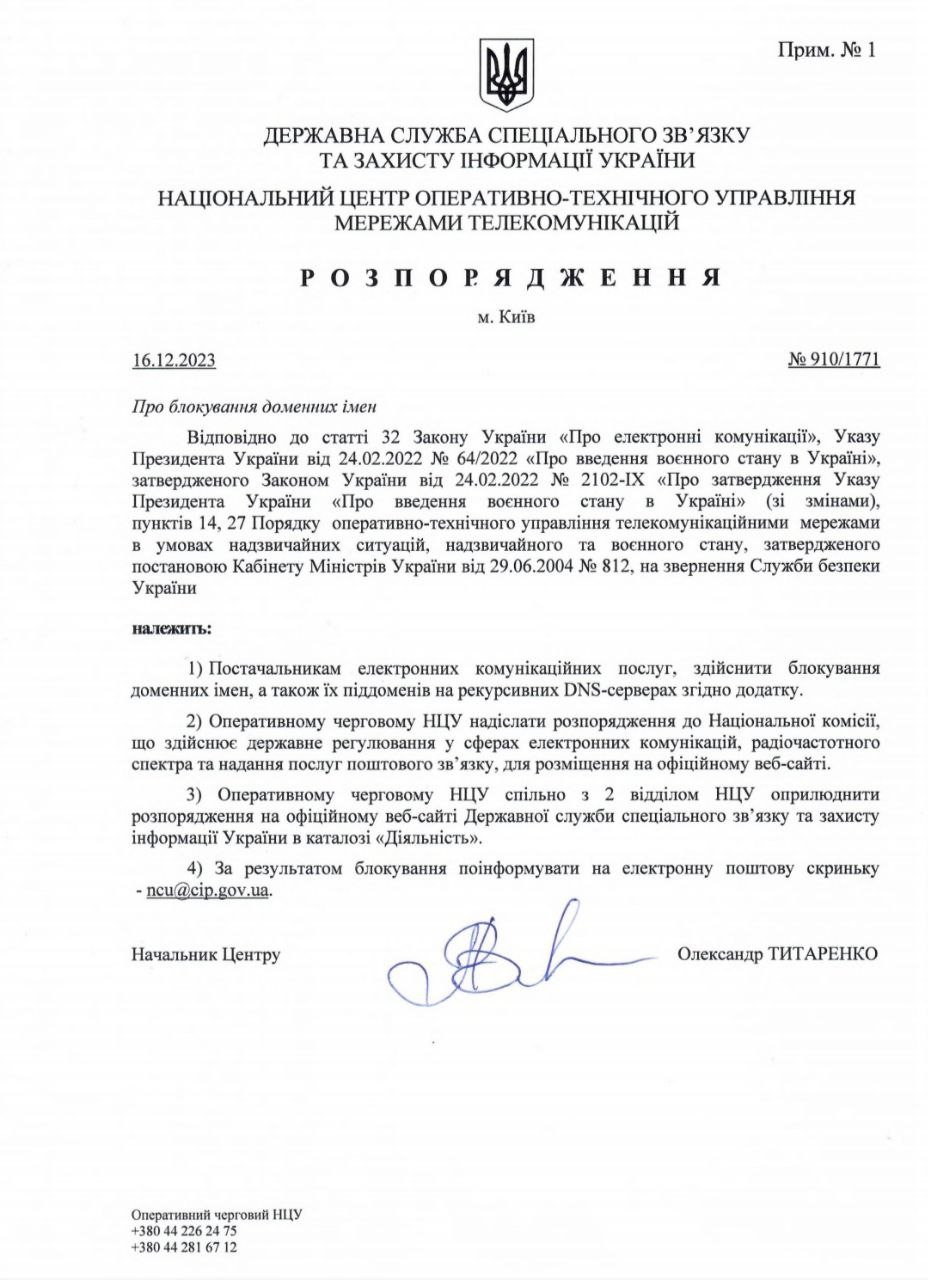
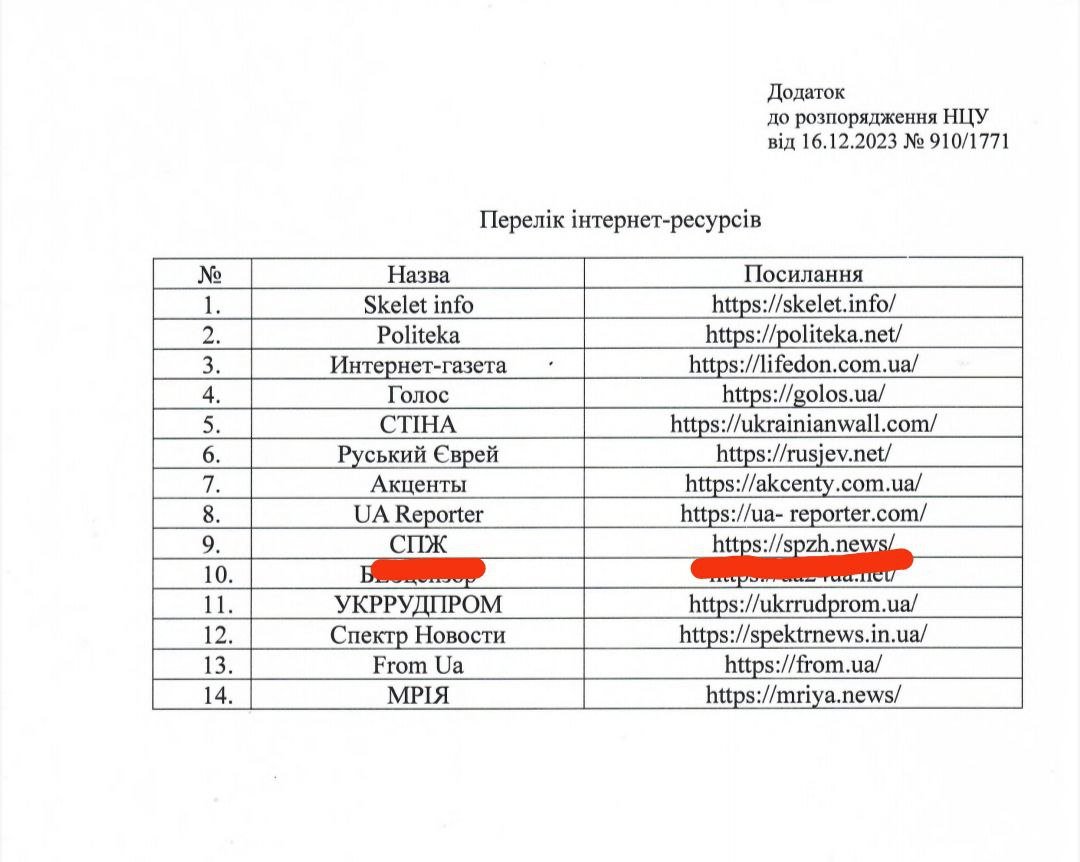
The documents provided by the State Service do not explain the reasons or motivations for blocking the domain of the information resource.
On April 5, 2024, information emerged about the blocking of a number of media outlets covering the life and activities of the Ukrainian Orthodox Church.
The following websites became inaccessible: the website of the UOC Synodal Information and Education Department (news.church.ua), new UOJ domain (spzh.media), "Orthodox Life" (pravlife.org), Raskolam.net (raskolam.net).
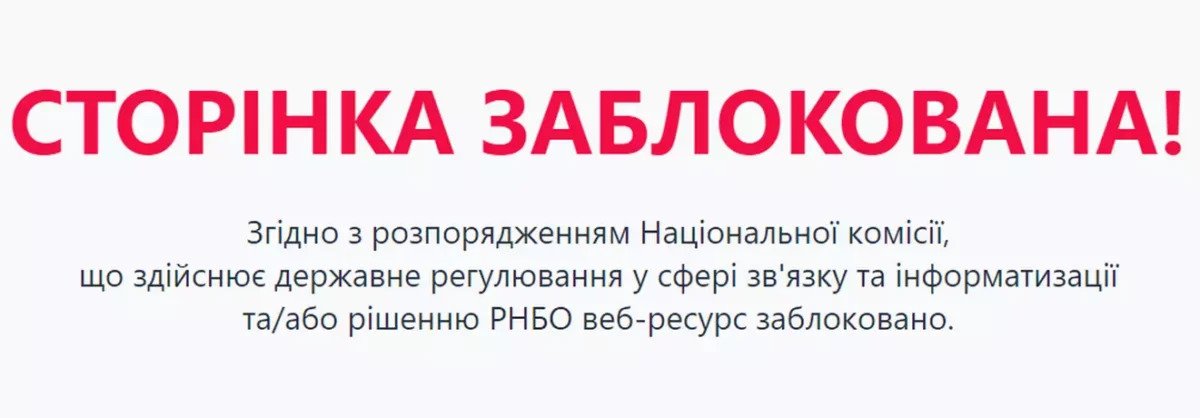
Internet providers are blocking access with the following message:
"PAGE BLOCKED! Pursuant to an order of the National Commission exercising state regulation in the field of communications and informatization and/or a decision of the National Security and Defense Council, this web resource has been blocked."
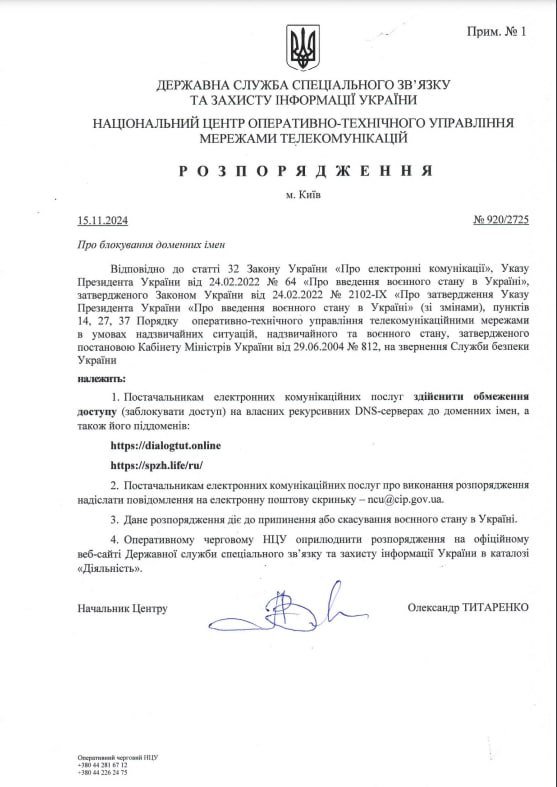
On November 16, 2024, the UOJ editorial team reported yet another blocking of its website domain by order of the SBU.
The UOJ website, as well as the website of the information resource Dialog.tut, were again blocked by order of the State Service of Special Communications and Information Protection.
The new domain of the UOJ was blocked: spzh.life
On January 10, 2025, the State Service of Special Communications issued an order to electronic communications service providers to block the UOJ website in Ukraine.
Providers are required to report the blocking of the resource spzh.eu by notifying the Special Communications Service by email. The blocking remains in effect until the end of or the lifting of martial law.
As stated by the State Service of Special Communications in its order, the blocking was carried out at the request of the SBU.
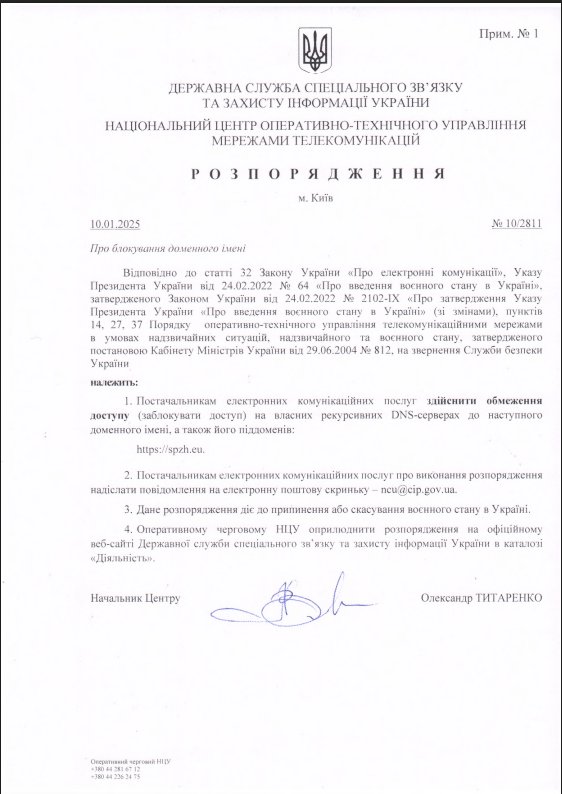
Journalists report that this was already the fifth blocking of the Union of Orthodox Journalists resource.
On 16.12.2023, a decision was published to block the domain spzh.news
13.03.2024 – spzh.media
12.09.2024 – spzh.live
15.11.2024 – spzh.life
(Source: UOJ)
In January 2025, UOJ lawyers sent a notice to a number of international human rights organizations regarding the violation in Ukraine of the right to freedom of speech through the blocking of the Union of Orthodox Journalists website, as well as other Ukrainian publications covering the life of the Ukrainian Orthodox Church.
The document sets out in detail the Ukrainian and international laws that Ukrainian authorities have violated.
The publication released the document in full.
"In July 2024, the company 'TEAM OF THE ORTHODOX JOURNALISTS (TOJ) LTD' was registered in the territory of the EU.
The principal activity of this company is the publication on its website on the Internet of journalistic articles covering the activities of the Ukrainian Orthodox Church.
In particular, the articles raise issues of protecting the rights of believers to freely profess their religion, to perform religious rites and ritual ceremonies without hindrance, and to engage in religious activity.
Also covered are the problems of violations in Ukraine of the rights of believers of the Ukrainian Orthodox Church, such as the violent seizure of churches by representatives of other religious denominations and by radicals, and the inaction of law enforcement agencies in connection with crimes committed against believers.
The website of the company 'TEAM OF THE ORTHODOX JOURNALISTS (TOJ) LTD' is popular among a large number of readers residing in Ukraine.
At the same time, state bodies of Ukraine are imposing disproportionate restrictions on freedom of religion and belief.
In particular, the National Center for Operational and Technical Management of Telecommunications Networks by electronic telecommunications service providers on 12.09.2024 issued Order No. 769/2574 on the restriction (blocking) of access in Ukraine to the domains https://spzh.live/ru/ and https://spzh.live/ua/, used by the Company.
Subsequently, analogous orders were issued on 15.11.2024 No. 920/2725 and on 10.01.2025 No. 10/2811 on the restriction (blocking) of access in Ukraine to the domains https://spzh.life/ru/ and https://spzh.eu, used by the Company.
The basis for such actions is the persecution of the Ukrainian Orthodox Church and the prosecution of Orthodox journalists. In this context, we note that in addition to 'TEAM OF THE ORTHODOX JOURNALISTS (TOJ) LTD', the official website of the Ukrainian Orthodox Church has been blocked in Ukraine, as have other resources covering the life of the UOC. In particular, 'Dialog.tut', 'Pravlife', 'Raskolam.net'.
Such arbitrary interference in journalistic activity is contrary to both the national legislation of Ukraine and international law.
Pursuant to Article 34 of the Constitution of Ukraine, everyone is guaranteed the right to freedom of thought and speech, and to the free expression of their views and beliefs. Everyone has the right to freely collect, store, use, and disseminate information orally, in writing, or in any other manner of their choosing.
Pursuant to Article 15 of the Constitution of Ukraine, social life in Ukraine is based on the principles of political, economic, and ideological pluralism. No ideology may be recognized by the state as mandatory. Censorship is prohibited.
In accordance with Article 4 of the Law of Ukraine "On Media," activities in the media sphere are based on the principles of freedom of expression of views and beliefs, freedom of dissemination, exchange, and receipt of information, freedom of activity of media entities, including the free determination of information content, freedom of economic activity in the media sphere, guaranteed right to information, openness and accessibility of information, reliability and completeness of information, lawfulness of obtaining, using, disseminating, storing, and protecting information, and protection of individuals from interference in their personal and family life. Censorship is prohibited. Unlawful interference in the activities of media entities by state bodies, local self-government bodies, public associations, political parties, owners of the relevant entities, or any other natural or legal persons is not permitted.
In accordance with Article 35 of the Constitution of Ukraine, everyone has the right to freedom of worldview and religion. This right includes the freedom to profess any religion or to profess no religion, to perform religious rites and ritual ceremonies individually or collectively without hindrance, and to engage in religious activity. The Church and religious organizations in Ukraine are separated from the state. No religion may be recognized by the state as mandatory.
Pursuant to Article 10 (freedom of expression) of the Convention for the Protection of Human Rights and Fundamental Freedoms, everyone has the right to freedom of expression. This right shall include freedom to hold opinions and to receive and impart information and ideas without interference by public authority and regardless of frontiers.
In accordance with the case law of the European Court of Human Rights (Fatullayev v. Azerbaijan), in cases concerning interference with the right to freedom of expression, it is necessary to determine whether such interference was necessary in a democratic society.
The Court must determine whether the reasons given by the national authority to justify the interference were "relevant and sufficient" and whether the measure taken was "proportionate to the legitimate aims pursued." In doing so, the Court must satisfy itself that the national authorities, basing themselves on an acceptable assessment of the relevant facts, applied standards that were in conformity with the principles embodied in Article 10 of the Convention (Chauvy and Others v. France).
As follows from the case law of the European Court of Human Rights (Fatullayev v. Azerbaijan; Handyside v. the United Kingdom), having regard to paragraph 2 of Article 10 of the Convention, freedom of expression is applicable not only to "information" or "ideas" that are favorably received or regarded as inoffensive or indifferent, but also to those that offend, shock, or disturb the state or any sector of the population. Such are the demands of pluralism, tolerance, and broadmindedness without which there is no "democratic society."
In a democratic society it is important that debate on matters of public concern be able to take place freely (Fatullayev v. Azerbaijan).
The Court must also exercise the utmost caution where measures taken or sanctions imposed by the national authority are of a nature likely to discourage the press from participating in the discussion of matters of legitimate public concern (Fatullayev v. Azerbaijan).
There is a violation of the right to freedom of expression where journalists are prohibited from covering matters of general interest (Mahmudov and Agazade v. Azerbaijan).
The limits of permissible criticism are wider with regard to the government than in relation to a private individual or even a politician. In a democratic system the actions or omissions of the government must be subject to the close scrutiny not only of the legislative and judicial authorities but also of public opinion. Furthermore, the dominant position which the government occupies makes it necessary for it to display restraint in resorting to criminal proceedings, even in response to unjustified attacks and criticism from its opponents, especially where other means are available (Incal v. Turkey).
The preamble to the Declaration of the Committee of Ministers of the Council of Europe on human rights and the rule of law in the information society recognizes that limited or absent access to information and communication technologies may deprive people of the ability to fully exercise their human rights.
The first chapter of the Declaration states that freedom of expression, information, and communication must be respected in both digital and non-digital environments and must not be subject to restrictions.
The preamble to the Declaration on Freedom of Communication on the Internet, adopted by the Committee of Ministers of the Council of Europe on 28.05.2023, states that prior control of communication on the Internet, regardless of frontiers, must remain exceptional, and that barriers to individual access to the Internet must be removed.
The Declaration provides that public authorities must not, through general blocking or filtering measures, deprive the public of access to information on the Internet, regardless of frontiers.
In Recommendation 2008/2160(INI), adopted by the European Parliament on 26.03.2009, it is explicitly stated that states should make efforts to establish e-democracy on the basis of full access to the Internet. Therefore, the Parliament recommended that member states condemn government-imposed censorship of content searchable on Internet sites and called on them to ensure that freedom of expression is not subjected to arbitrary restrictions by the state, and to avoid any legislative or administrative measures that could have a restrictive effect on all aspects of freedom of speech.
The UN Human Rights Committee, in its General Comment No. 34 on Article 19 of the International Covenant on Civil and Political Rights, noted that it is impermissible to prohibit a website or information distribution system from publishing material on the grounds that it may contain criticism of the government or the political social system supported by the government.
In light of the foregoing, we request that appropriate measures be taken within the scope of your authority to restore the violated rights.
The letter was sent to: the UN High Commissioner for Human Rights, the OSCE Representative on Freedom of the Media, Amnesty International, Human Rights Watch, Human Rights House Foundation, Freedom House, The Netherlands Helsinki Committee, International Bar Association, The American Society of International Law, ARTICLE 19, The International Federation of Journalists (IFJ), Access Now, Committee to Protect Journalists, International Media Support, International Partnership for Human Rights, PEN International, Reporters without Borders, IFEX International Freedom of Expression Exchange, International Center for Journalists, The Electronic Frontier Foundation, The European Federation of Journalists (EFJ), Free Press Unlimited, The International Press Institute (IPI), Advox (project of Global Voices), The Independent Journalism Center (IJC), Index on Censorship, The World Association of News Publishers, SOCIEDAD INTERAMERICANA DE PRENSA, Open Media, U.S. Commission on International Religious Freedom, World Council of Churches, The International Association for Religious Freedom, International Christian Concern, Open Doors, The Christian Institute, ADF International, Christian Solidarity Worldwide, In Defense of Christians, Religious Freedom Institute."
Such arbitrary interference in journalistic activities violates both Ukrainian national law and international law.
Under Article 34 of the Constitution of Ukraine, everyone is guaranteed the right to freedom of thought and speech, and to the free expression of their views and convictions. Everyone has the right to freely collect, store, use, and disseminate information orally, in writing, or by other means—at their own discretion.
According to Article 15 of the Constitution of Ukraine, public life in Ukraine is based on the principles of political, economic, and ideological diversity. No ideology may be recognized by the state as mandatory. Censorship is prohibited.
In accordance with Article 4 of the Law of Ukraine “On Media,” activities in the media sector are based on the principles of freedom of expression of views and beliefs, freedom of dissemination, exchange, and receipt of information, freedom of operation for media entities, including the free determination of information content, freedom of economic activity in the media sector, the guarantee of the right to information, openness and accessibility of information, accuracy and completeness of information, the lawfulness of obtaining, using, disseminating, storing, and protecting information, and the protection of individuals from interference in their private and family life. Censorship is prohibited. Unlawful interference in the activities of media entities by state bodies, local government bodies, public associations, political parties, owners of such entities, or any other natural or legal persons is not permitted.
In accordance with Article 35 of the Constitution of Ukraine, everyone has the right to freedom of worldview and religion. This right includes the freedom to profess any religion or none at all, to freely practice religious rites and rituals, either individually or collectively, and to engage in religious activities. The church and religious organizations in Ukraine are separate from the state. No religion may be recognized by the state as mandatory.
According to Article 10 (freedom of expression) of the Convention for the Protection of Human Rights and Fundamental Freedoms, everyone has the right to freedom of expression. This right includes the freedom to hold opinions and to receive and impart information and ideas without interference by public authorities and regardless of frontiers.